
AI Search is becoming a real channel for B2B buyers. Tools like ChatGPT, AI Mode or Copilot are increasingly used to research and shortlist vendors. Brands that move early on new channels tend to win. This guide evaluates 7 AI Search Optimization agencies across Europe that are actually building visibility in AI tools, not just rebranding old SEO services with a new name.
Key takeaways
- AI Search is already a pipeline channel. ChatGPT, Perplexity, and Google AI Mode are not future threats. They’re driving vendor discovery today, especially in B2B SaaS. If you’re not showing up there, you’re not on the shortlist.
- The “AI SEO” label is getting overused. Many agencies are rebranding existing services without changing their methodology. Before you engage, ask for a case study that shows measurable AI visibility improvements
- The KPI shift is real. The metric that matters is no longer rankings or traffic. It’s whether your brand gets mentioned when a potential buyer asks an AI assistant to recommend tools like yours.
- Europe has strong options at different price points. The agencies on this list range from lean specialist shops to full-execution growth partners. The right fit depends on your stage, budget, and how seriously you’re treating AI Search as a revenue channel.
- SEO and AI Search are not competing priorities. The strongest content foundation you build for Google also feeds AI visibility. The best agencies optimize both surfaces simultaneously.
Why AI Search is replacing traditional SEO more and more
For decades, the goal of SEO was simple: Rank #1, get the click. Today, the user journey has changed fundamentally.
Shift from clicks to answers
For twenty years, the game was simple: rank higher, get more clicks. That model is breaking down faster than most marketing teams have acknowledged. Google’s own AI Overviews now answer queries directly on the results page, absorbing intent that used to generate clicks. Ahrefs data from early 2026 shows AI Overviews reduce organic clicks by 58% on affected queries. That’s not a rounding error — it’s a structural shift in how search converts.
The buyer isn’t clicking through to compare ten articles anymore. They’re asking a question and getting a synthesized answer. If your brand didn’t contribute to what the AI knows about the category, you’re invisible at the most critical moment of the research process.
AI Platforms as New Gatekeepers
ChatGPT crossed 400 million weekly active users in early 2025. Perplexity is growing rapidly as a research-first alternative to Google. Google AI Mode is rolling out globally, sitting on top of the most trafficked search engine in the world. These platforms are becoming the new gatekeepers between your content and your buyers and they have their own logic for who they cite.
A Responsive study from 2025 found that one in four B2B buyers already use generative AI more than traditional search when researching suppliers. In tech and software, that number jumps to 80%. Your buyers are already there. The question is whether you are.
SEO alone is no longer enough
Traditional SEO is still important. Don’t let anyone tell you to abandon it. But it’s no longer sufficient on its own. An agency that only optimizes for Google rankings is leaving an entire buyer discovery layer completely unaddressed.
The companies winning right now are the ones building content and authority signals that work across both surfaces — Google and AI Search — simultaneously. That requires a different methodology, a different content architecture, and a different way of measuring success.
AI Search Optimization as a new system
This is what makes AI Search Optimization distinct from SEO or GEO as typically defined. It’s not about adding a few FAQ sections and hoping ChatGPT picks you up. It’s a systematic approach to building the kind of topical authority, citation triggers, structured content, and brand mentions that make large language models consistently recommend your solution.
The agencies on this list understand that system. Most don’t.
Disclaimer:
Before we get into the list: I’m Niklas, CEO of Radyant.
So yes, this perspective is biased.
But instead of pretending otherwise, I want to be transparent about it.
I evaluated these agencies based on publicly available work, documented case studies, content quality, and what I’ve seen from working in this space since 2013. I haven’t spoken to all of them. I’m transparent where my knowledge has limits.
Use it as a starting point, not a final answer
What is AI Search Optimization?
SEO vs GEO vs AI Search Optimization
These three terms get used interchangeably by agencies trying to sound current. They’re not the same thing.
-
SEO (Search Engine Optimization) is the practice of optimizing content and technical infrastructure to rank in traditional search engines — primarily Google. It’s built around keywords, backlinks, crawlability, and on-page optimization. Still essential. Still working.
-
GEO (Generative Engine Optimization) emerged as a term to describe optimizing for AI-generated answers. Most definitions focus on getting cited in Perplexity, ChatGPT, or Google AI Overviews. The term is useful but often misused. Many agencies put “GEO” on their website without having changed a single thing about how they work.
-
AI Search Optimization is how we at Radyant describe the full system: combining SEO fundamentals with GEO tactics — citation triggers, entity building, prompt tracking, structured content designed for LLM consumption and measuring the outcome in terms of pipeline, not just mentions. It’s not a rebrand. It’s a different methodology with different inputs, different outputs, and different tools.
KPI Shift: From Rankings to Mentions to Pipeline
If your agency is still reporting primarily on keyword rankings and organic traffic, they’re measuring the wrong thing. Those metrics are proxies. They used to correlate reasonably well with business outcomes, and they still matter, but they’re no longer sufficient.
The new KPI hierarchy looks like this: Does your brand show up in AI-generated answers when buyers research your category? Does that visibility translate to qualified traffic from AI platforms? Does that traffic convert into pipeline? These are the questions a serious AI Search partner should be able to answer. If you want to understand how this tracking actually works in practice, our breakdown of prompt tracking and AI Search visibility measurement explains the methodology.
Importance of visibility in AI answers
The reason this matters so much is the buyer journey structure. When a potential customer asks ChatGPT “what’s the best tool for [your category]?” they’re often at the start of a research process that will end in a demo request or a purchase. If you’re not in that first answer, you may never make their shortlist — regardless of how well you rank on Google.
This is especially acute in B2B SaaS, where 80% of tech buyers now use AI tools in their research process. Getting into that top-of-funnel AI discovery layer is increasingly the difference between being considered and being invisible.
How I evaluated the best agencies in Europe
I used five criteria to assess every agency on this list. These aren’t arbitrary. They’re the questions you should be asking any potential AI Search partner before you sign a contract.
-
AI visibility track record. Does the agency have documented, measurable results from AI platforms — actual citations in ChatGPT or Perplexity, AI referral traffic, or measurable mention growth — rather than theoretical frameworks and blog posts about what GEO could do?
-
B2B SaaS focus. AI Search Optimization for consumer brands is a different discipline than for B2B software. The agencies on this list understand the B2B buyer journey: longer research cycles, multiple stakeholders, intent that lives in very specific query categories.
-
Content and technical depth. Building AI visibility requires both strong content (topical authority, citation-worthy structure, original research) and technical execution (schema, entity optimization, prompt tracking infrastructure). Agencies that only do one half are missing the other.
-
Proof over promises. I only included agencies that can point to real client outcomes, not just internal blog posts, not just LinkedIn thought leadership, not just vague “AI-first” positioning statements.
-
Thought leadership. In a space this new, the agencies worth working with are the ones actively figuring things out in public. Publishing original research. Running experiments. Being honest about what works and what doesn’t yet.
The 7 best AI search optimization agencies in Europe
Here’s a side-by-side snapshot before diving into the detail. Use it to shortlist, then read the profiles.
| Agency | Primary Focus | Best For | Pricing* | Geography |
|---|---|---|---|---|
| Radyant | Full-funnel organic growth, SEO & AI Search | Startups and scaleups | Starting at €7,000/mo | DACH, Europe |
| Omnius | International B2B SEO & GEO | SaaS and Fintech exclusively | Custom Pricing | London, remote |
| Skale | AI search-first organic growth | SaaS brands with link-building needs | Custom Pricing | London, remote |
| Delante | International SEO & AI Search | E-commerce, mid-market | Custom Pricing | Poland, remote |
| Embarque | SEO & AI Search | Early-stage, budget-conscious startups | From ~$3,000/mo | Remote (EU heavy) |
| Exposure Ninja | Full-service digital marketing | SMEs, diverse industries | Custom Pricing | UK, remote |
| Peak Ace | Performance SEO & AI Search | Enterprise, e-commerce | Custom Pricing | Berlin, Europe |
*Pricing is estimated if not publicly disclosed, as of March 2026.
Detailed comparison
Here’s a closer look at each agency:
1) Radyant
Radyant was founded in 2019 with a specific goal: build the leading organic growth agency in Europe for startups and scaleups that want pipeline, not pageviews. Since then, the focus has expanded from pure SEO to a full-system approach covering both Google and AI Search — tracking brand mentions across ChatGPT, Perplexity, and Google AI Mode, and connecting that visibility directly to CRM data and revenue.
What separates Radyant from most agencies on this list is the combination of strategic depth and genuine execution infrastructure. We don’t hand over a strategy deck for your internal team to implement. We run the whole operation: buyer journey research, content production at scale using custom AI infrastructure, technical SEO, and dashboards that connect organic performance to qualified leads.
The results are documented. For Enter, a German climate tech startup, we built content and interactive tools — including a heat pump cost calculator — that gained direct citations in ChatGPT. Combined with a targeted content strategy, this took Enter from near-zero to 100,000 monthly visitors and over 5,000 leads in two years. For ToolSense, we 10x’ed B2B inbound leads in two years entirely from organic. For a bootstrapped PropTech, we 5x’ed inbound leads from SEO and AI Search.
Radyant works primarily in DACH but serves clients across broader European markets.
Best for: B2B startups and scaleups that are post-PMF, have a defined ICP, and want an agency that connects organic directly to pipeline, not just traffic dashboards.
Pricing: Our organic grow (SEO/AEO) package starts at €7,000/month.
The full pricing transparency you can find here.
2) Omnius
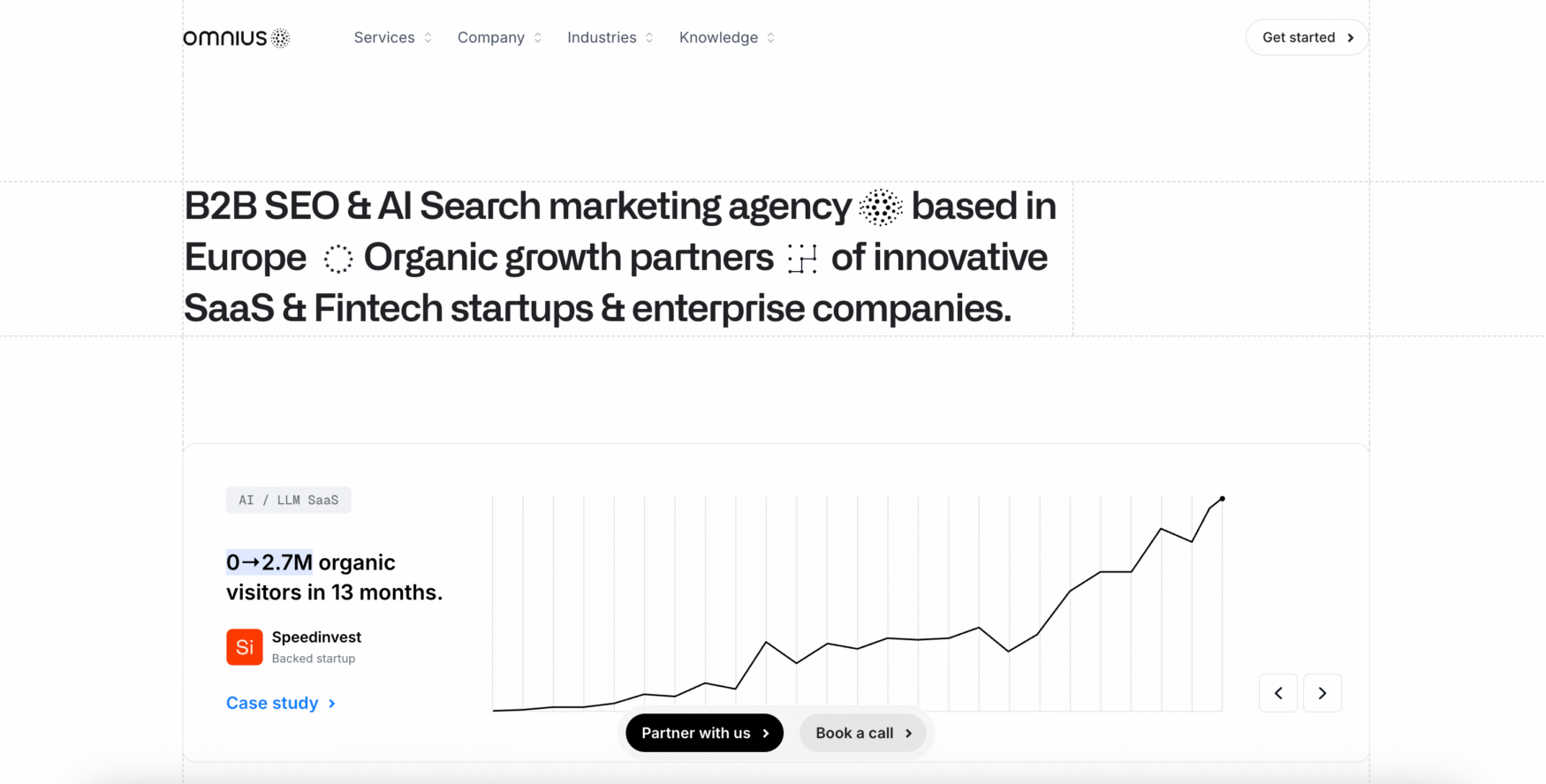
Omnius s a London-based agency working exclusively with B2B SaaS, Fintech, and AI companies. That vertical depth is a genuine advantage if you sit squarely in those categories — their understanding of the SaaS buyer journey translates directly into content that attracts the right intent. Their AI Search approach is research-driven: they built their own citation tracking infrastructure early and are transparent about the evolving nature of LLM optimization. For companies outside their core verticals, the fit is weaker. For SaaS and Fintech specifically, they’re a serious option.
Best for: B2B SaaS, Fintech, and AI companies that want a specialist partner exclusively focused on their vertical.
Pricing: Custom Pricing.
3) Skale
Skale positions itself as an AI search-first organic growth agency for tech and SaaS brands. Their model is built heavily around link-building and off-page authority alongside content, which makes them a strong choice for companies that have already established SEO foundations and need to accelerate backlink acquisition alongside AI visibility. For companies still building topical authority from scratch, their model is less comprehensive. The off-page emphasis works best when on-page fundamentals are already solid.
Best for: SaaS scaleups with existing SEO foundations looking to accelerate authority and AI Search visibility simultaneously.
Pricing: Custom Pricing.
4) Delante
Delante is a Poland-based international SEO agency that has been building a genuine AI Search capability over the past two years. Their strength is international, multi-language SEO execution at scale. They work across markets and have the infrastructure to support multilingual content strategies. Their AI Search offering is more recent and still developing compared to more specialized players, but they bring strong fundamentals and a transparent, results-focused culture that makes them a credible option for e-commerce and mid-market companies with international ambitions.
Best for: E-commerce and mid-market companies needing international SEO coverage combined with growing AI Search capabilities.
Pricing: Custom Pricing.
5) Embarque
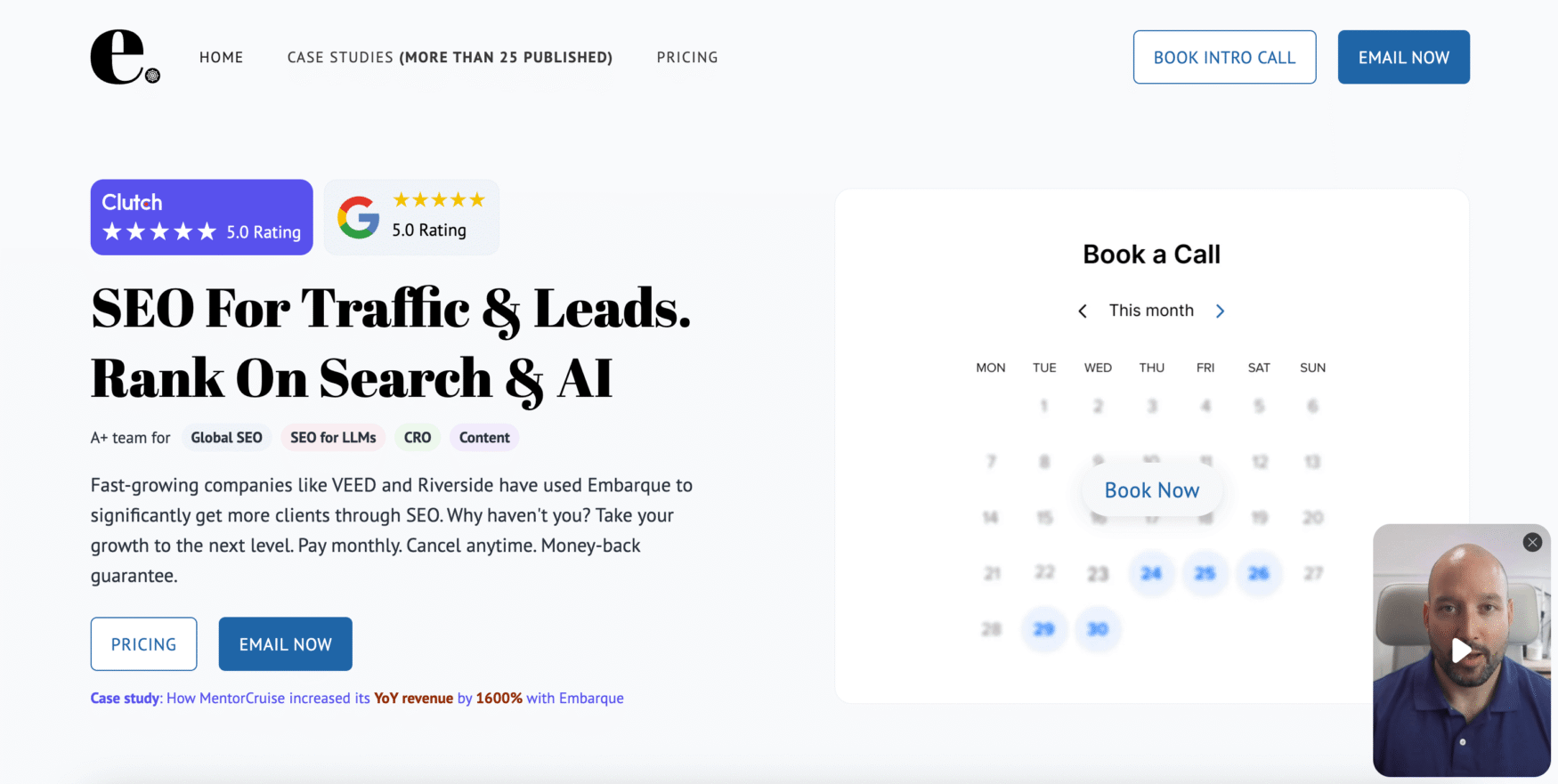
Embarque fis a remote-first agency working primarily with early-stage B2B SaaS companies. Their pricing starts significantly lower than most agencies on this list, and their model is built for speed and simplicity, which is exactly right for pre-Series A teams operating with lean marketing budgets and no room for six-month strategy phases. For companies past that stage that need more strategic depth, more complex execution, or broader market coverage, they’ll likely feel underpowered. Within their lane, they deliver solid work at accessible pricing.
Best for: Pre-Series A SaaS startups wanting fast, practical AI Search and SEO execution without enterprise-level overhead.
Pricing: Custom Pricing.
6) Exposure Ninja
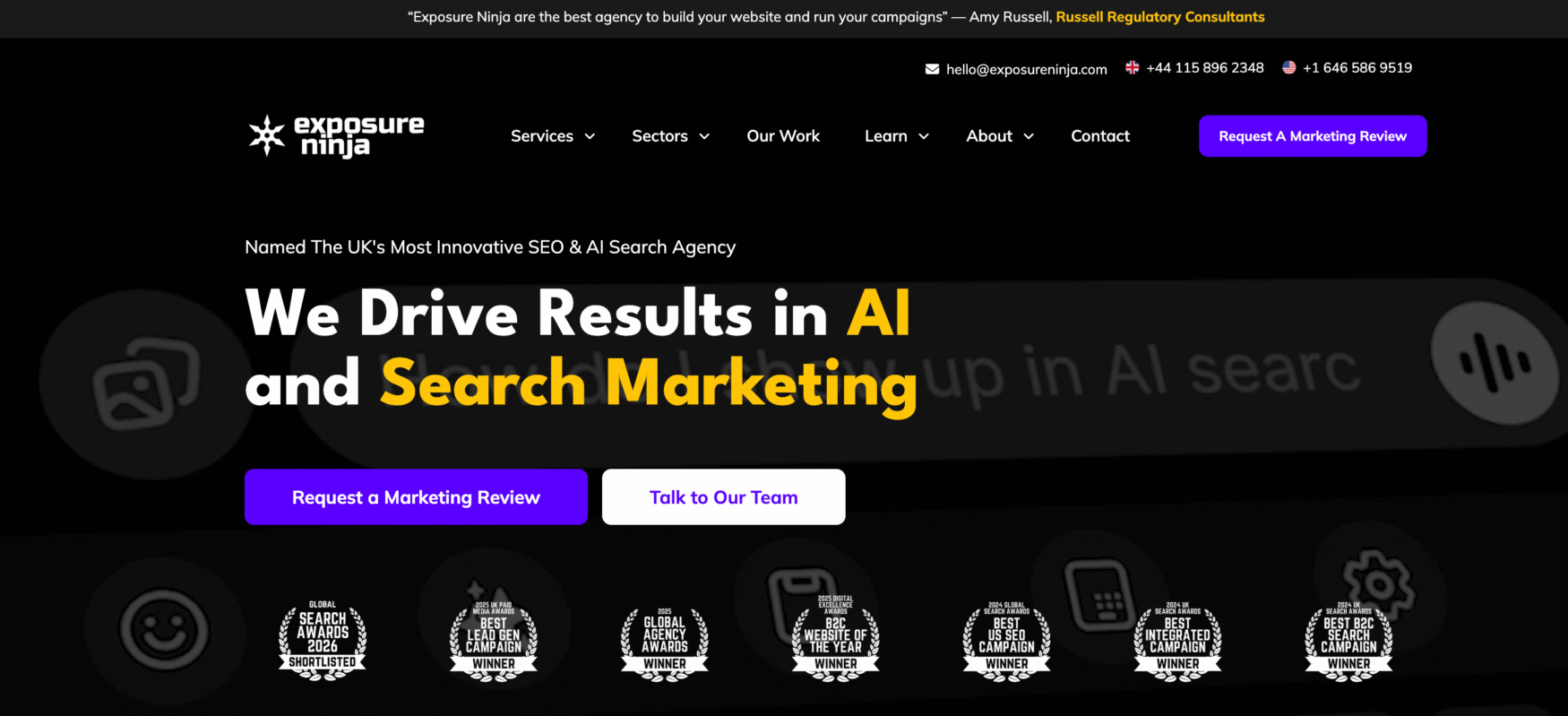
Exposure Ninja is a UK-based full-service digital marketing agency that has built a genuine SEO track record over more than a decade and is now incorporating AI Search into its offering. Their breadth — covering SEO, paid media, content, and web design — is an advantage for smaller companies that want a single partner across multiple channels. For companies that need deep AI Search specialization, that same breadth can be a limitation. They’re strongest as an all-in-one partner for SMEs and growing businesses, less so as a pure-play AI Search optimization shop.
Best for: SMEs and growing businesses that want broad digital marketing coverage including SEO and AI Search, without managing multiple specialist agencies.
Pricing: Custom Pricing.
7) Peak Ace
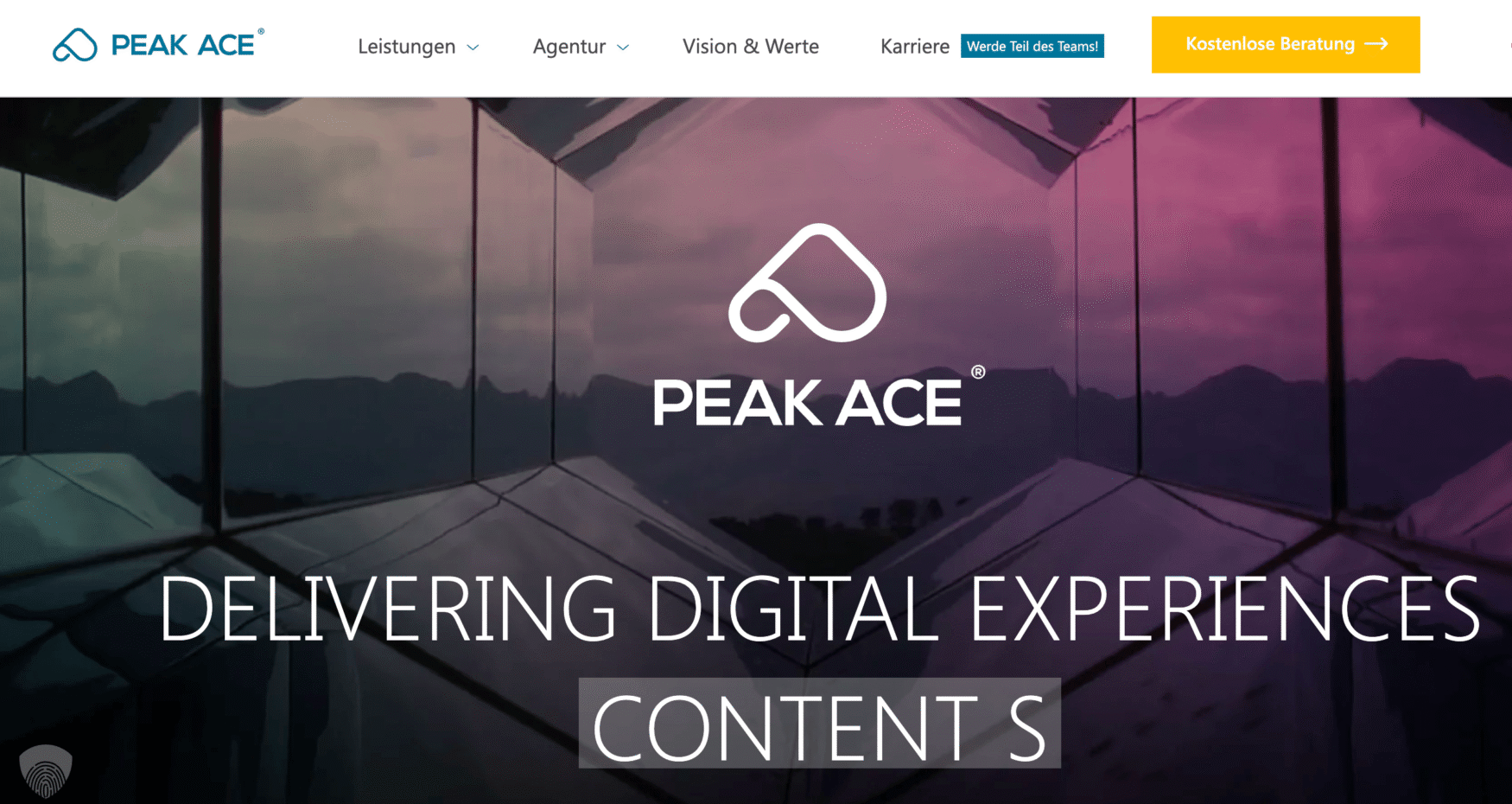
Based in Berlin, Peak Ace is a performance marketing and SEO agency with a strong enterprise track record and genuine technical depth. They’ve been operating in competitive European markets for over fifteen years and have built multilingual, multi-market SEO programs for major brands across e-commerce, travel, and finance. Their AI Search capability is developing. They’re applying strong technical SEO foundations to the new challenge, but the pure-play AI Search specialization is less mature than agencies that have built around it from the start. For enterprise brands that need technical rigor and cross-channel integration, they’re a credible option.
Best for: Enterprise and large-scale e-commerce companies needing technically rigorous SEO programs with growing AI Search coverage.
Pricing: Custom Pricing.
Not sure where you stand on AI Search?
Before you hire anyone, it’s worth understanding your actual visibility. Where does your brand appear when buyers ask AI tools to recommend solutions in your category? What’s the gap between you and your competitors? What would it take to close it?
We run free growth audits that answer exactly these questions, no commitment, no vague slide decks, just a clear picture of your AI Search and organic growth potential. Book a free growth audit with Radyant.
What most agencies still get wrong
-
They confuse content production with AI Search Optimization. Publishing more blog posts is not a GEO strategy. LLMs don’t reward volume. They reward the content that best answers specific questions with authority and structure. Agencies that are scaling up content output without changing content architecture are running harder on a treadmill that’s going slower.
-
They don’t track what they claim to optimize. If an agency can’t show you a dashboard with your brand’s citation rate in ChatGPT and Perplexity over time, they’re not actually measuring AI visibility. They’re guessing. Real AI Search Optimization requires prompt tracking infrastructure — running the queries your buyers actually ask and monitoring where you appear. We cover the methodology in detail in our guide on AI Search attribution.
-
They treat AI Search as a separate silo. The best AI visibility comes from the same things that drive great SEO: topical authority, original research, structured content, strong backlink profiles. Agencies that optimize for AI Search in isolation, without connecting it to their broader content strategy, are missing the compounding effect of doing both well.
-
They’re optimizing for mentions instead of pipeline. Getting your brand mentioned in a ChatGPT answer is a means to an end, not the end itself. The agencies worth hiring can show you how AI visibility translates to traffic, how that traffic converts, and what the pipeline value is. If they can only report on citation counts, they’re optimizing vanity metrics.
What actually works
After several years of running AI Search programs for B2B startups and scaleups across Europe, here’s what we know moves the needle.
- Build for questions, not keywords. LLMs are trained to answer questions. The content that gets cited is the content that most directly and authoritatively answers the specific questions buyers ask. This means mapping your content strategy to the actual prompts your ICP uses in AI tools — which is often different from the keywords they use in Google.
- Earn citations through original data and tools. AI systems cite sources they consider authoritative. The fastest way to build that authority is to create things that are genuinely worth citing: original research, proprietary data, interactive calculators, and structured comparison content. Our Enter case study is a good illustration. The heat pump calculator became a cited source in ChatGPT because it provided something AI couldn’t generate itself.
- Get mentioned across the web, not just your own site. LLMs draw on a wide corpus of content. Brand mentions in third-party publications, reviews, podcast transcripts, and industry content all contribute to AI visibility. A strong digital PR and content strategy that earns mentions across your category is foundational.
- Use structured content that LLMs can parse. Clear headings, concise definitions, FAQ sections, comparison tables, and summary paragraphs all make it easier for AI systems to extract and cite your content. This isn’t about gaming the algorithm — it’s about writing content that’s genuinely useful and easy to consume, for humans and AI alike.
- Track prompts, not just traffic. Set up a prompt tracking system that monitors your visibility across the queries your buyers actually run. Run them regularly. Track trends over time. Connect them to referral traffic from AI platforms. This is how you know if what you’re doing is working. We built our own infrastructure for this. The methodology is described in our prompt tracking guide.
When to hire an agency
Hiring an agency is the right move when at least one of these conditions is true.
- You don’t have the internal expertise. AI Search Optimization is a new discipline. The methodology is still being figured out in real time, including by us. If your marketing team has strong SEO fundamentals but hasn’t built AI citation tracking or structured content programs for LLM consumption, the learning curve is steep and the opportunity cost of getting it wrong is high.
- You don’t have the bandwidth. Even if you have the knowledge, AI Search Optimization requires consistent execution: content production, prompt tracking, technical optimization, ongoing measurement. For most lean marketing teams, this competes directly with everything else on the roadmap. An agency gives you execution capacity without the fixed cost of headcount.
- You need results on a timeline. Building AI visibility from scratch takes time, but an experienced agency can compress that timeline significantly by applying a tested playbook rather than running experiments from zero. If you have a funding round coming up, a competitive threat accelerating, or a growth target that organic needs to contribute to, the speed advantage of working with an experienced partner matters.
- The ROI math works. At €4,000–€10,000+ per month, agency fees are meaningful. The question is whether the pipeline value of AI Search visibility exceeds that cost at your conversion rates and deal sizes. For most B2B SaaS companies with ACV above €10k, it does. Often within the first six months of a well-executed program. If you want to sense-check the math for your specific situation, a free growth audit is the place to start.
Conclusion
AI Search isn’t coming. It’s here. And the brands that are building visibility across ChatGPT, Perplexity, and Google AI Mode right now are building a compounding advantage that will be very difficult to replicate later. The window for being an early mover in your category is still open, but it’s narrowing.
The seven agencies in this guide each bring genuine strengths for different stages, budgets, and market contexts. What matters most when choosing is not who has the most impressive website or the most impressive-sounding methodology. It’s who can show you real results from real AI platforms for real clients.
If Radyant sounds like a fit, book a free growth audit. We’ll give you an honest picture of where you stand on AI Search and what it would take to close the gap with your competitors. No commitment. No vague deck. Just a clear starting point.
And if you want to keep learning while you’re evaluating options, the Masters of Search Podcast and our Marketing Breakdowns are good places to go deeper.
Frequently asked questions
What is AI Search Optimization?
AI Search Optimization is the practice of building content, authority signals, and brand visibility so that AI platforms like ChatGPT, Perplexity, and Google AI Mode cite and recommend your brand in generated answers. It combines traditional SEO fundamentals with specific tactics for LLM consumption: citation triggers, entity building, prompt tracking, and structured content designed for AI systems.
How is AI Search Optimization different from SEO and GEO?
Traditional SEO focuses on ranking in Google. GEO (Generative Engine Optimization) typically refers to optimizing for AI-generated answers. AI Search Optimization as we define it is the full system — combining SEO and GEO with pipeline tracking, so visibility in AI answers is connected directly to leads and revenue, not just mention counts.
How long does it take to see results from AI Search Optimization?
Initial citation signals typically appear within 8–12 weeks of a well-executed program. Meaningful referral traffic from AI platforms and measurable pipeline impact usually starts showing up by month 4–6. Compounding visibility effects build from there as topical authority deepens.
Do I still need SEO if I’m investing in AI Search?
Yes. SEO fundamentals — topical authority, high-quality content, strong backlink profiles, technical site health — are also the inputs that drive AI visibility. The two disciplines are complementary, not competing. Agencies that optimize both surfaces simultaneously consistently outperform those that treat them as separate programs.
How do I evaluate whether an agency actually does AI Search Optimization vs. rebranding old SEO?
Ask three questions: Can you show me a case study with measurable AI citations or AI-platform referral traffic for a client? How do you track brand visibility in ChatGPT and Perplexity? How do you connect AI visibility to pipeline metrics? If they can’t answer all three with specific examples and documented methodology, the GEO label is cosmetic.
What’s the right budget for AI Search Optimization in Europe?
Serious AI Search programs in Europe typically run from €5,000–€15,000+ per month depending on scope, market complexity, and execution depth. The right budget depends on your deal size, conversion rates, and the size of the organic pipeline opportunity in your category.
Which European markets are hardest to build AI Search visibility in?
DACH markets present specific complexity due to language nuance, GDPR considerations, and research-intensive buyer behavior. That said, the lower density of AI-optimized content in German-language markets also creates a significant first-mover opportunity for brands that invest early. Our comparison of the best GEO agencies in Germany goes into more detail on what works in that region specifically.