
Your CEO forwards you a LinkedIn post titled “SEO is dead” and asks if you should reallocate budget. Your board wants to know why organic traffic is flat. Meanwhile, your last five inbound leads all told sales they “found you on ChatGPT,” but GA4 says they came from Direct. If you’re a marketing leader trying to figure out whether SEO still deserves a seat at the table in 2026, the answer is more nuanced than the headlines suggest. Here’s the data, the frameworks, and the honest assessment you need to make that call.
Key takeaways
- Search is not dying. Google processes 15 billion+ searches per day, and organic traffic is down only 2.5% year-over-year. AI search accounts for roughly 6% of global search volume but is growing 3x annually. The shift is real but gradual, not a collapse.
- The biggest threat to your SEO ROI isn’t AI search. It’s measuring the wrong things. Most companies still track traffic and rankings while ignoring pipeline, citation share, and the massive attribution blind spot where AI-referred leads show up as “Direct” in analytics.
- What’s dying is surface-level informational content and traffic-as-KPI thinking. What’s thriving is intent-dense buying-journey content, brand SEO, and owned content authority that works across both Google and AI search simultaneously.
- SEO delivers 702% ROI for B2B SaaS with a 7-month breakeven, while Google Ads CPCs have surged 40-50% since 2020. Organic remains the highest-ROI channel for B2B, but only if you connect it to pipeline and revenue rather than vanity metrics.
Looking for a shortcut to drive more organic growth from your content, SEO & AI Search efforts? Request a free growth audit from Radyant to get an honest assessment of your organic growth potential.
The data: is search actually dying?
Every few years, the “SEO is dead” narrative resurfaces. It happened after Panda, after mobile-first indexing, and now it’s happening because of AI Overviews and ChatGPT. The narrative is persistent. But the data tells a different story.
Graphite’s analysis of actual traffic data shows that SEO traffic is only down 2.5% year-over-year. Not 20%. Not 50%. Two and a half percent. Traffic to search engines has been relatively flat since 2023 (-1.0%), and visitors to Google actually increased by 1.4% comparing Q4 2025 vs. Q4 2024.
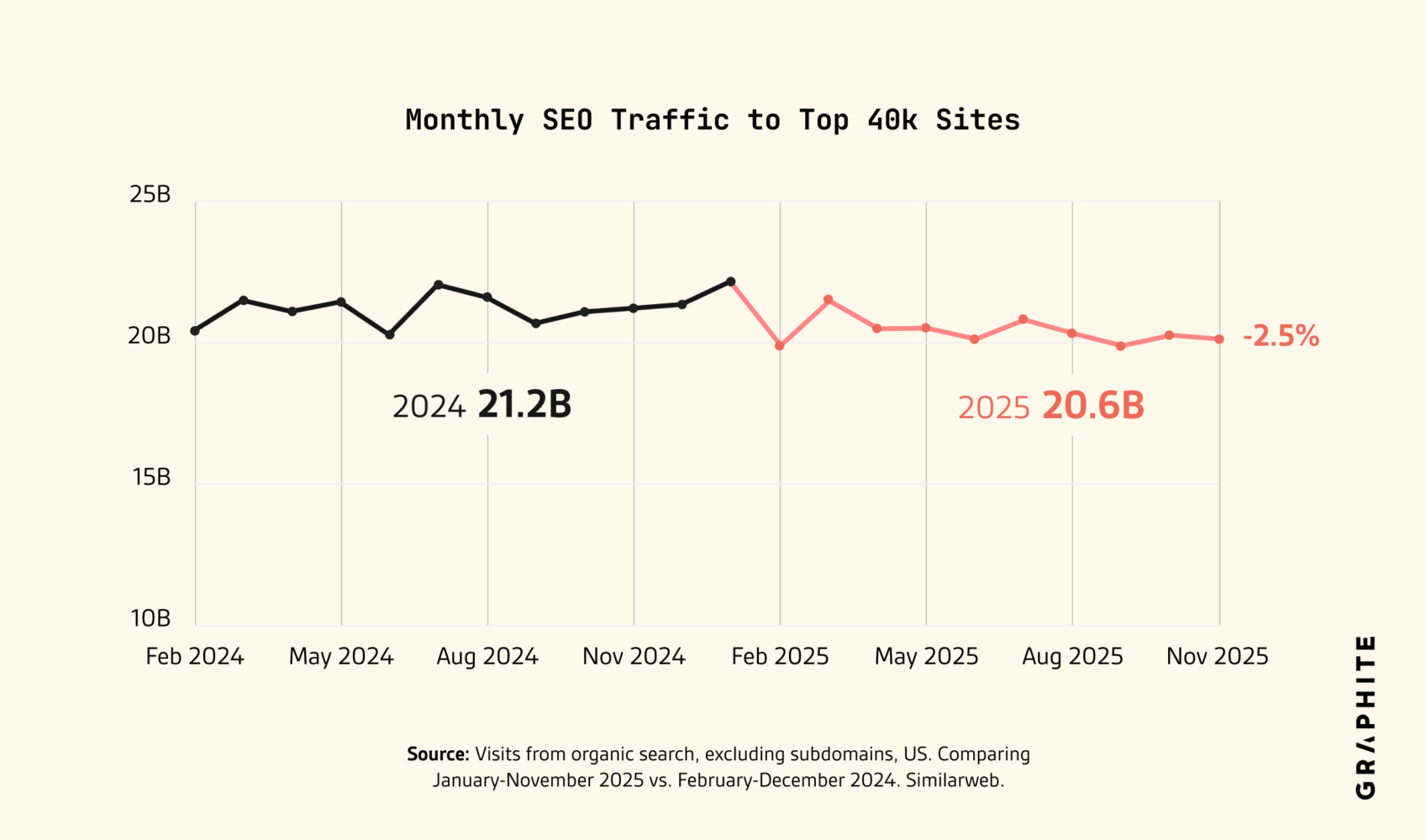
Google still processes over 15 billion searches per day. AI and LLM searches account for about 6% of global search volume. That’s roughly triple what it was a year ago, so the growth trajectory is real. But we’re talking about 6% versus 94%. This isn’t a replacement story yet. It’s an expansion story.
Here’s what the data actually shows when you break it down:
-
The largest sites are growing. The top 10 sites grew organic traffic by about 1.6%. Declines are concentrated among mid-sized publishers ranked between the top 100 and 10,000, according to Search Engine Land’s analysis.
-
Zero-click searches are real but not new. 60% of searches end without a click, with mobile leading at 77%. But Google showed Featured Snippets in 80% of cases where AI Overviews now appear, and those already reduced CTR. The zero-click trend predates AI by years.
-
AI Overviews reduce clicks by about 35% when present, but they only appear in roughly 30% of searches, per Ethan Smith’s research at Graphite.
-
Transactional, navigational, and complex research queries still generate clicks. The queries losing clicks are simple informational ones where a direct answer suffices.
The narrative that search is dying is, as Ethan Smith puts it, “based on a series of myths driven by speculation, exaggeration, flawed analysis, and false information.” That doesn’t mean nothing is changing. It means the change is more specific and more nuanced than the headlines suggest.
What’s genuinely dying in SEO (and what’s thriving)
The honest answer to “should SEO still be part of my strategy?” requires acknowledging that parts of the old SEO playbook are genuinely losing value. Pretending everything is fine is just as unhelpful as declaring SEO dead.
As Panstag captures well: “If your site mainly publishes surface-level information, SEO in 2026 feels unrewarding because the platform no longer needs your page.” That’s accurate. Google and AI models can answer “What is CRM software?” without sending anyone to your glossary page. If that’s the core of your SEO strategy, you have a problem.
But the solution isn’t to abandon SEO. It’s to shift what you’re doing within SEO.
What’s losing value
-
“What is” glossary pages. AI answers these directly. Your 800-word definition page adds nothing that ChatGPT can’t synthesize from 50 sources.
-
Traffic as the north star metric. HubSpot’s estimated organic traffic dropped roughly 80% according to third-party tools, concentrated in top-of-funnel informational content. Yet HubSpot reported $3.13B in revenue in 2025, up 19% year-over-year. Traffic went down. Revenue went up. If you’re still reporting on traffic as your primary SEO metric, you’re measuring the wrong thing.
-
Keyword-first content planning. Starting with a keyword list and working backward to content topics produces generic output that looks like everything else on page 1.
-
Thin informational content at scale. 500-word blog posts that exist to capture a keyword but add no original insight, data, or perspective.
-
Vanity ranking reports. Showing your CEO that you rank #3 for a keyword with 50 monthly searches and zero pipeline impact.
What’s gaining value
-
Deep buying-journey content. Comparison pages, evaluation frameworks, implementation guides, and content that serves someone actively making a purchase decision. These queries still generate clicks because the user needs to engage with the content, not just get a quick answer.
-
Pipeline and citation share as KPIs. How many leads came from organic? What percentage of AI search answers in your category cite your content? These are the metrics that matter.
-
Expert-driven, charge-worthy depth. Content with original data, proprietary frameworks, real case studies, and perspectives that can’t be synthesized from existing sources. This is what both Google and AI models want to surface, because it’s what users actually find valuable.
-
Audience-first research. Starting with what your buyers actually need to know (from sales calls, customer interviews, support tickets) rather than what a keyword tool says has volume.
-
Brand SEO. Branded search carries intent, trust, and significantly higher conversion potential, and these are exactly the signals AI systems favor. Building brand recognition through search is shifting from a marketing byproduct to a strategic initiative.
The attribution problem nobody’s talking about
This is the section that matters most for anyone making budget decisions. Because the biggest threat to your SEO investment isn’t AI search eating your traffic. It’s that your analytics are lying to you about where your leads actually come from.
Here’s what happens in 2026: A potential buyer asks ChatGPT, “What’s the best asset management software for mid-size facilities?” ChatGPT mentions your brand. The buyer types your brand name into Google. Clicks your homepage. Fills out a demo request. Your CRM records this as “Organic Search” or “Direct.” ChatGPT gets zero credit.
This isn’t a hypothetical. Across our client work at Radyant, we consistently see leads who self-report discovering the brand through AI search but show up as Direct or Organic in click-based analytics. At ToolSense, where we helped 10x inbound demo bookings over two years, the gap between what analytics reported and what prospects actually said widened significantly as AI search grew.
This creates a dangerous feedback loop: marketing leaders look at their attribution data, see that “AI search” drives almost nothing, and conclude it’s not worth investing in. Meanwhile, the actual influence of being cited in AI answers is invisible in their dashboards.
The 3-layer attribution model
No single attribution method gives you the full picture in 2026. You need to triangulate across three layers:
Layer 1: Click-based attribution. Your CRM and GA4 data. Keep it running. It’s useful for direct-click channels like paid search. But stop treating it as the only truth for discovery channels. It systematically undercounts AI search, word-of-mouth, podcast mentions, and any journey where the user doesn’t click a trackable link.
Layer 2: Self-reported attribution. Add a “How did you hear about us?” field to your forms. Make it mandatory. Make it free-text, not a dropdown (dropdowns force people into categories that might not match their actual journey). LLMs now make analyzing thousands of free-text responses trivial. This is where you’ll discover how many leads actually came from ChatGPT, Perplexity, or a podcast episode.
Layer 3: Verbal attribution from sales. What prospects say in the first call. “Oh, I asked ChatGPT for recommendations and your name kept coming up.” Most of this intel dies in the call recording. Fix this with a custom CRM field that sales fills in after every discovery call. Make it part of the process, not optional.
When we implemented this model with Heyflow, the results were striking: AI-attributed trials were converting at 14.3%, compared to the 11% channel average. AI search wasn’t just driving awareness. It was driving higher-quality leads. But without Layers 2 and 3, that insight would have been completely invisible.
If your attribution setup can’t tell you how many leads came from AI search, that’s the first problem to solve. Talk to us about getting your tracking right.
The economics: SEO vs. paid for B2B SaaS
Let’s talk numbers, because this is ultimately a budget allocation decision.
SEO delivers 702% ROI for B2B SaaS companies with a break-even time of 7 months. Organic search generates 44.6% of all B2B revenue, making it the single largest revenue channel. Separate benchmarking puts SEO’s B2B marketing ROI at 748%, the highest of any channel measured.
Meanwhile, on the paid side: Google Ads cost per click jumped 13% in 2024 versus 2023. Compared to 2020, CPCs have surged 40-50%. And this trend isn’t reversing. As more advertisers compete for the same queries and Google continues to expand ad placements, paid acquisition costs will keep climbing.
The fundamental economic difference: paid search is rented attention. The moment you stop spending, the leads stop. SEO compounds. Every page you publish, every piece of authority you build, continues working for you. The cost per lead from organic decreases over time as your content library grows. Organic search costs between $480 and $942 per customer initially, with long-term costs potentially dropping to $290 as the compounding effect kicks in.
We saw this compounding effect clearly with ToolSense: 10x inbound demo bookings over two years. Not because we kept spending more. Because the content and authority we built in year one kept generating returns in year two, while each new piece added to the base.
This doesn’t mean you should abandon paid search. It means you should understand the trajectory of each channel. If your CAC on paid is rising 13% per year while your organic CAC is declining as content compounds, the math becomes very clear over a 24-month horizon.
Three shifts that change how you should do SEO
The question isn’t whether to invest in SEO. It’s whether you’re investing in the right version of SEO. Here are the three shifts that matter most for B2B SaaS marketing leaders in 2026.
Shift 1: Best answer wins across all platforms
There’s a growing industry of “AEO experts” selling AI-specific optimization tactics: prompt-style writing, citation optimization, content chunking. Most of what they’re selling is good UX and content strategy repackaged with new branding. Question-based headings? We’ve used those for years because users have specific questions. Key takeaways upfront? Standard practice because users don’t have time to scroll. These “tactics” work in AI search because they worked for users first.
The sustainable strategy: make your content the best, most complete, most trustworthy answer to the user’s question. Google wants to serve that. ChatGPT wants to cite that. Perplexity wants to reference that. They all have the same incentive: surface the most helpful content.
We proved this with Planeco Building: 5x organic leads in 10 months, citation share from 55% to over 130%, and #1 AI search visibility in their competitor set. The method? We made their owned content the definitive answer in their space. No Reddit outreach. No backlink chasing. No separate “AI-optimized” content versions. Just depth, expertise (extracted through regular interviews with the co-founders), and content that addressed what their audience actually needed to know.
As Andy Muns, Director of AEO at Telnyx, discussed on our Masters of Search podcast: AEO might just be SEO. The overlap is massive, and treating them as separate disciplines creates unnecessary complexity and duplicated effort.
Shift 2: Brand SEO becomes the growth engine
When someone asks ChatGPT for a recommendation and your brand gets mentioned, what happens next? They search your brand name on Google. They visit your homepage. They convert at a much higher rate than someone who clicked a generic informational result.
This is why brand SEO is becoming critical. Branded search carries intent, trust, and significantly higher conversion potential. It’s exactly the signal AI systems favor when deciding which brands to recommend. And it means your homepage experience matters more than ever, because it’s increasingly the entry point after AI-driven brand discovery.
The practical implication: your SEO strategy needs to include building the kind of content authority and brand recognition that makes AI models mention you by name. This isn’t separate from SEO. It’s the highest-value form of SEO.
AI search visitors are already proving this out. LLM visitors convert 4.4x better than organic search visitors. ChatGPT traffic specifically converts at 15.9%, Perplexity at 10.5%. These aren’t casual browsers. They’re people who received a recommendation and are now evaluating whether to buy.
Shift 3: People will search more, not less
The assumption behind “SEO is dead” is that AI will replace search. But the evidence points in the opposite direction: AI is creating new search behaviors that didn’t exist before.
Think about planning a trip to Paris. Before AI, you might run 5-10 Google searches about hotels, restaurants, and activities. Now, you have a 20-minute conversation with ChatGPT that generates dozens of follow-up questions you wouldn’t have thought to ask. Each of those questions is a search behavior. Some happen inside the AI tool. Some spill over to Google for verification, booking, or deeper research.
Tinuiti’s analysis agrees: “People are searching more, using AI more, and expecting more thoughtful, contextual responses from both.” The total addressable market for search is expanding, even as the click-through rate on individual queries declines.
For B2B SaaS, this means your potential buyers are doing more research, across more platforms, before they ever fill out a form. The companies that show up consistently across Google, ChatGPT, Perplexity, and industry-specific sources will capture a disproportionate share of that expanded research journey.
As Ethan Smith discussed on Masters of Search, ChatGPT traffic converts six times better than Google search. The volume is smaller, but the intent density is dramatically higher. Fewer clicks, but better clicks. That’s not a crisis. That’s a strategic opportunity if you’re measuring the right things.
Decision framework: should YOU invest in SEO?
The answer isn’t a blanket yes. It depends on your specific situation. Here’s a framework for evaluating where SEO fits in your growth strategy:
B2B SaaS with a long sales cycle
SEO is likely your highest-ROI channel. Your buyers research extensively before engaging sales. They compare solutions, read reviews, evaluate features. Being the definitive resource throughout that journey compounds into pipeline. Recommendation: invest heavily, but shift focus from informational content to buying-journey content (comparisons, implementation guides, ROI frameworks). Measure pipeline contribution, not traffic.
Strong brand, declining organic traffic
Before cutting budget, fix your measurement. Your traffic decline may be concentrated in informational queries that AI now answers directly, while your buying-intent traffic and AI-referred traffic are growing. Implement the 3-layer attribution model. Check what self-reported attribution says. You may discover that AI search is driving significant pipeline that your analytics can’t see. Recommendation: fix measurement first, then make budget decisions based on complete data.
Early-stage startup with no content
SEO compounds, so starting now creates an advantage that gets harder for competitors to close over time. The objection that “SEO takes too long” is less true than it used to be. With programmatic content engineering, results can come fast. When we launched a 247-page programmatic cluster for Planeco Building, 140 pages were ranking in the Top 3 within 72 hours, generating 60+ leads in under 6 months. Recommendation: start building now, use content engineering to accelerate, and pair with paid for immediate demand capture while organic compounds.
Traffic-rich but pipeline-poor
You don’t have an SEO problem. You have a strategy problem. Your content is attracting the wrong audience or failing to convert the right one. This usually means too much top-of-funnel informational content and not enough mid-to-bottom-funnel content that serves buyers with purchase intent. Recommendation: audit your content against the buying journey. Shift production toward intent-dense content. Improve conversion paths on existing high-traffic pages. This is a doing more with less problem, not a “do more SEO” problem.
Highly competitive market with established players
Head-to-head competition on generic keywords is expensive and slow. But programmatic content targeting long-tail, specific queries can carve out territory quickly. Combined with a strong owned content authority play on your core differentiators, you can build visibility without needing to outspend incumbents. Recommendation: focus on specificity over volume. Own the niche queries your competitors ignore. Winning against 100x budgets is possible when you compete on depth and relevance rather than domain authority alone.
The new SEO KPIs
If you take one thing from this article, let it be this: stop reporting on traffic as your primary SEO metric. You will not see organic traffic in public SaaS investor presentations. If traffic were a true north star, it would appear in investor reporting. It doesn’t, because investors care about revenue and pipeline.
Here’s what to track instead:
-
Pipeline from organic. How many qualified opportunities originated from organic search (including AI search, captured through the 3-layer model)?
-
Revenue attributed to organic. Closed-won revenue where organic played a role in the journey.
-
Citation share. What percentage of AI search answers in your category mention your brand? Tools like Peec AI can track this. We covered the Peec AI vs. Profound comparison in detail.
-
Conversion rate by channel. Compare organic, AI search (self-reported), paid, and direct. You’ll likely find AI search converts at a premium.
-
Self-reported attribution trends. Track the percentage of leads mentioning AI search tools over time. This is your early warning system for how the channel is growing.
-
Branded search volume. Growing branded search indicates your content and AI visibility are building recognition that converts downstream.
Traffic and rankings still have a place as operational metrics for your SEO team. They’re useful for diagnosing issues and tracking execution. But they should not be the metrics you present to leadership or use for budget decisions.
Want to see how this framework applies to your specific situation? Request a growth strategy audit and we’ll map your organic opportunity against your pipeline goals.
The bottom line
SEO isn’t dead. But the version of SEO that many companies are still practicing, focused on traffic volume, generic informational content, and keyword-first planning, is losing value fast.
The version of SEO that’s thriving looks different: owned content authority that serves as the best answer across Google and AI search simultaneously. Buying-journey content that converts. Brand building that makes AI models recommend you by name. And measurement that actually captures the full picture of how search drives pipeline.
Organic search still generates 44.6% of all B2B revenue. AI search traffic converts at 4.4x the rate of traditional organic. Google Ads CPCs are climbing 13% per year while organic compounds. The economic case for SEO has never been stronger, if you’re doing it right and measuring it correctly.
The real question isn’t “should SEO be part of my marketing strategy?” It’s “am I doing the right kind of SEO, and can I actually see its impact?” If the answer to either is no, that’s not a reason to cut budget. It’s a reason to fix the approach.
FAQ
Is SEO dead because of AI search?
No. AI search accounts for roughly 6% of global search volume. Google still processes 15 billion+ searches per day, and total search volume is expanding as AI creates new research behaviors. What’s changing is the type of content that earns visibility. Surface-level informational content is losing value, while expert-driven, intent-dense content is gaining value across both Google and AI platforms.
How long does SEO take to show results for B2B SaaS?
The average breakeven for B2B SaaS SEO is 7 months. But timelines vary significantly based on approach. With programmatic content engineering, we’ve seen pages ranking in the Top 3 within 72 hours and generating leads within 3 months. Traditional content-led SEO typically shows meaningful pipeline impact within 6-10 months. The compounding effect means months 12-24 are where the ROI accelerates significantly.
Should I invest in GEO/AEO separately from SEO?
In most cases, no. What’s being sold as “AEO optimization” is largely good content strategy and UX that has always worked for SEO. Question-based headings, clear key takeaways, structured data, and comprehensive depth all serve both Google and AI models because they serve users. Treating them as separate disciplines creates duplicated effort. The exception: you should separately track and measure AI search visibility (citation share) and implement the attribution layers needed to capture AI-referred leads.
How do I measure SEO ROI when traffic is declining?
Stop measuring traffic as your primary KPI. Implement the 3-layer attribution model: click-based analytics (GA4/CRM), self-reported attribution (mandatory free-text form field), and verbal attribution from sales (custom CRM field). Track pipeline from organic, revenue attributed to organic, citation share in AI search, and conversion rates by channel. You may find that traffic is down but pipeline is stable or growing, because the clicks you’re getting are higher-intent.
What if my CEO says “SEO is dead” based on a LinkedIn post?
Share the data: organic search generates 44.6% of all B2B revenue, SEO delivers 702% ROI with 7-month breakeven, and Google Ads CPCs have increased 40-50% since 2020. Then reframe the conversation from traffic to pipeline. If your organic-attributed pipeline is healthy (once you measure it correctly with all three attribution layers), the argument makes itself. If it’s not healthy, the problem is likely your SEO strategy, not SEO as a channel.
Is it too late to start investing in SEO?
No, but the window for easy wins is closing. As AI search grows, the brands that have already built content authority and citation share will have a compounding advantage. Starting now is significantly better than starting in 12 months. The key is to start with the right approach: audience-first research, buying-journey content, and proper attribution from day one. Don’t repeat the mistakes of the old playbook by chasing traffic with thin informational content.