
Moss, Pleo, Circula, Pliant, and Candis are among the fastest-growing FinTech companies in the DACH region. All targeting similar ICPs. But when a CFO asks ChatGPT which expense management tool to use: who actually gets recommended? We analyzed 25 prompts across four AI platforms to find out. The results are clearer than expected.
In this breakdown, we cover:
- 5 brands analyzed: Moss, Pleo, Circula, Pliant, Candis
- 4 AI platforms: ChatGPT, Perplexity, Google AI Overviews, Google AI Mode
- 25 prompts targeting B2B FinTech users in the German-speaking market (DACH)
- Full analysis: AI Visibility %, Sentiment Score, Average Position, Owned vs. Earned Sources
Want to know how visible your brand is in AI search and what it would take to close the gap? Get your free AI visibility audit.
Interactive Miro Board with the full FinTech AI Search Breakdown (by Radyant)
How we set up our prompts: Measuring AI search visibility starts with the right prompts. Generic keyword-style prompts don’t reflect how people actually ask AI tools for recommendations. We designed our prompt set around real buyer intent in German, covering discovery, feature comparison, compliance, and switching scenarios. Want to learn how optimal prompt tracking works, which mistakes to avoid, and where the sweet spot is? Read our full guide on how to actually measure AI search visibility.
Comparison content controls the narrative
AI tools rely heavily on comparison content when answering purchase-related prompts. Even without an explicit comparison query, platforms like Perplexity primarily pull from listicles and comparison articles as sources. This makes competitive comparison content a core lever for shaping how your brand is perceived in AI search.
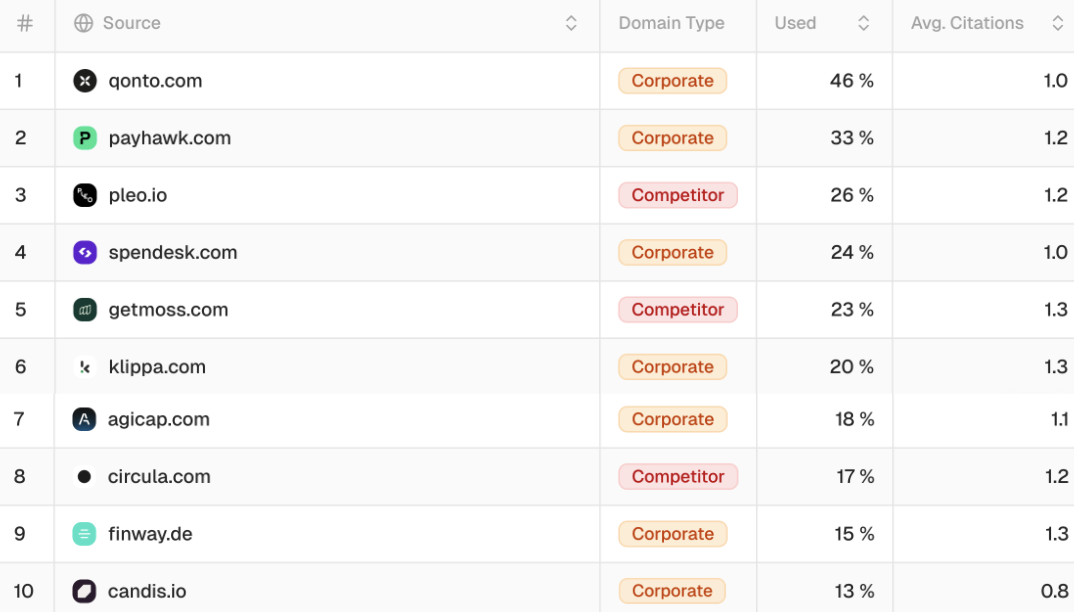
One company outside the five we analyzed illustrates this perfectly: Qonto. 9 out of 13 of Qonto’s most-cited sources are competitive comparison articles. By creating these articles themselves, Qonto sets the comparison criteria, controls the narrative, and leads the comparison by default. They link directly to central feature pages and work with two CTAs – an email opt-in lead magnet for low-intent users and a demo booking for high-intent users. The conversion funnel is covered for both stages of the buyer journey.
Why it matters: Every buyer goes through a comparison phase. If you’re not visible in the content that shapes that phase, you’re losing the deal before it even starts. Brands that create their own comparison content set the criteria and gain a structural advantage over those that only get compared.
Owned content is the #1 AI visibility lever
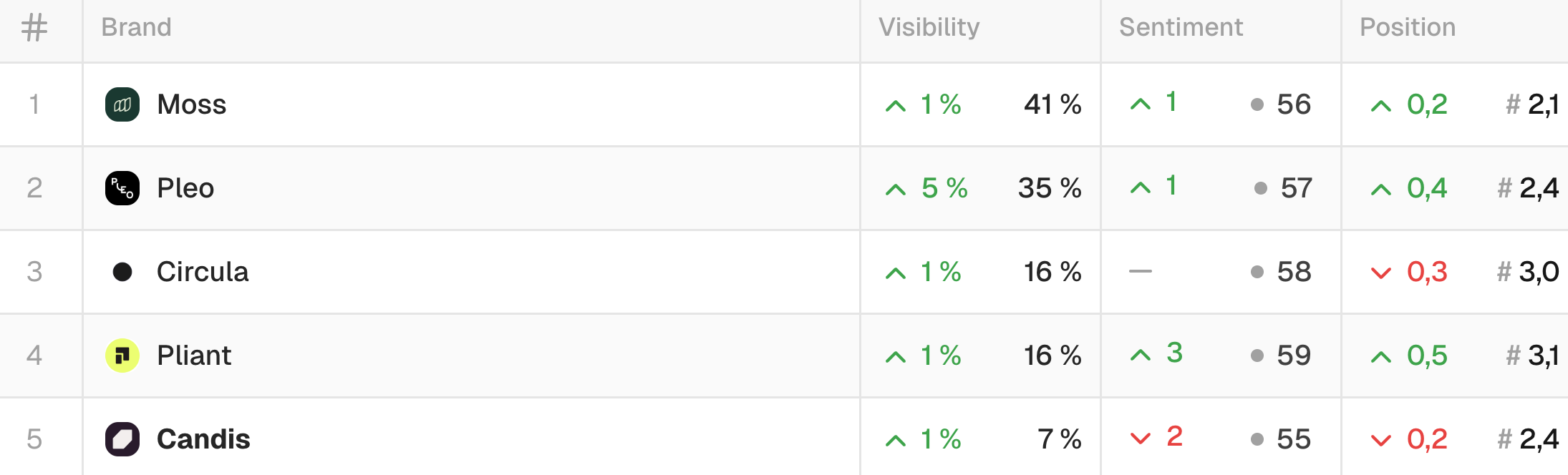
The AI visibility ranking in this analysis paints a clear picture:
- Moss leads the overall AI visibility ranking
- Pleo follows in second place, with the most sources referenced overall
- Pliant doesn’t appear in the top 10 sources across the entire prompt set
What Moss and Pleo share: strong owned content. Moss’ most-referenced product page combines conversion optimization with a clear presentation of features and USPs, plus a comprehensive FAQ section. Yes, FAQs – not exactly reinventing the wheel. But for AI search, they’re structurally ideal: they reflect real user questions and deliver directly usable answers for AI models.
Product pages can be very powerful when it comes to AI Sources. When they’re specific, well-structured, and closely aligned with actual user intent, they become high-value assets that AI models actively pull from. Moss demonstrates what happens when a product page is simultaneously optimized for conversions and AI visibility.
Meanwhile, Pliant doesn’t appear in the top 10 sources across the entire prompt set, despite being a well-known player in the space. At the other end of the spectrum, Pleo leads in the total number of sources referenced, but that alone doesn’t translate to the highest visibility.
Why it matters: The biggest lever for AI visibility almost always lies in your own content – whether that’s product pages, blog posts or help center articles. What counts is well-structured, and directly answers the questions your audience is asking.
Full FinTech AI Search Breakdown (by Radyant)
AI visibility is prompt-specific
There is no single winner across all prompt categories. Each brand dominates in different areas:
- Feature and use-case prompts: Fragmented — no single brand dominates. Pleo leads on operational topics like receipt capture, Pliant on card-specific queries, Circula on travel expenses and real-time controls.
- High-intent discovery prompts: Moss and Pleo dominate — where users are actively searching for a solution. Pliant shows up for card- and limit-focused queries. Circula and Candis barely register.
- Compliance and accounting prompts: Candis is the strongest player. For XRechnung and ZUGFeRD, Candis is the only visible provider. Circula appears for DATEV integration. The other three don’t register.
The data shows a clear segmentation: Moss and Pleo win broad awareness. Circula, Pliant, and Candis, on the other hand, are only visible for specific topic areas. Whether that’s by design or a gap in their content strategy is a different question, but it means they’re missing from a significant share of the prompts where their audience is actively searching.
Why it matters: AI visibility is prompt-specific. What matters is which prompts your target audience actually uses, and whether you show up there. Identify the exact prompts that map to your buyer journey and optimize specifically for those.
YouTube and Reddit have untapped potential
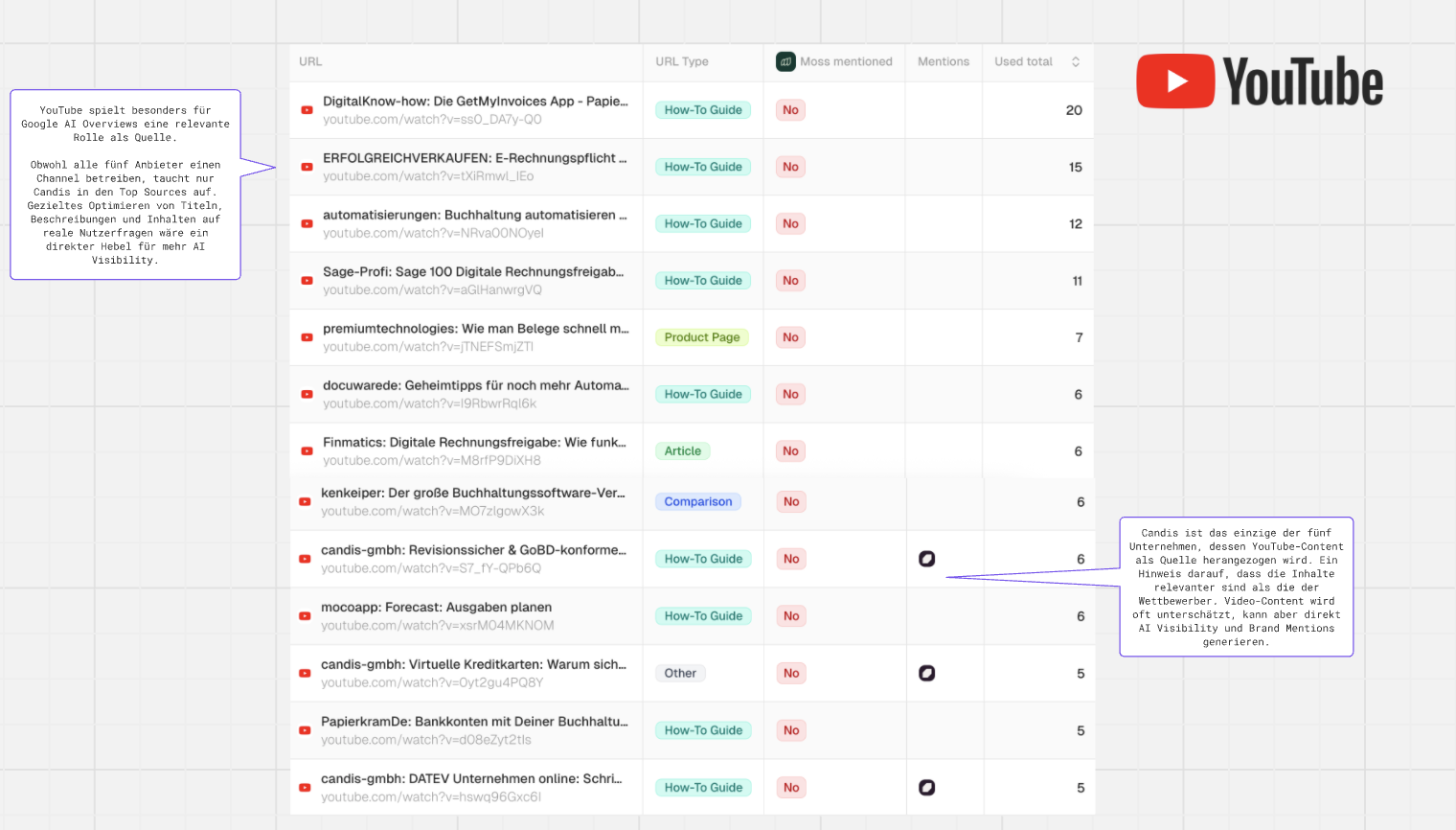
All five brands have a YouTube channel. Not one appears in the top AI citation sources. YouTube as a domain is the #2 overall earned source at 39 %, but those citations go to third-party review videos, explainer content from creators, and how-to tutorials from unaffiliated channels. Only one of them – Candis – gets cited as an AI source. It comes down to a strategic mix: content that directly answers real user questions, paired with titles and descriptions that clearly signal the topic and intent to AI models.
Video content is often underestimated, but it can directly generate AI visibility and brand mentions.
YouTube plays a particularly relevant role for Google AI Overviews as a source. Targeted optimization of video titles, descriptions, and content around real user questions would be a direct lever for more AI visibility.
Reddit as a UGC source accounts for 24 % of citations, with organic brand mentions in threads flowing directly into AI answers. Teams that strategically engage on Reddit can have a real lever here.
Why it matters: In this FinTech breakdown, YouTube and Reddit are active citation sources that AI models pull from when building recommendations. A well-structured YouTube video with optimized titles and descriptions, or a strategically placed Reddit thread, can directly influence whether your brand gets mentioned.
Full FinTech AI Search Breakdown (by Radyant)
Product pages and help centers are underestimated AI sources
Well-structured product pages with FAQs and solution-oriented help center articles are actively used as AI sources. These are assets that many companies already have, but rarely optimize for AI search.
Product pages aren’t always the first thing that comes to mind when thinking about AI search visibility. But they can be highly relevant sources – when they’re specific, well-structured, and close to actual user intent. Moss is a good example: its most-cited sources are primarily product pages. The top one combines conversion optimization with clear feature descriptions and a comprehensive FAQ section that delivers AI models directly usable answers.
Help centers tell a similar story. Pleo already has two help center articles among its top sources – solution-oriented, specific content that answers real user questions. That’s a strong signal for how much untapped potential sits in help center content.
Why it matters: You likely already have product pages and a help center. The question is whether they’re optimized for AI search. Structured FAQs that mirror real user queries, clear feature descriptions, and solution-oriented help center content are among the most effective AI visibility assets you can build and the barrier to entry is lower than most think.
We do these breakdowns because we love digging into the data, but also because this is exactly what we do at Radyant every day. We help companies figure out where they stand in AI search, which prompts actually matter for their business, and how to build a content strategy that gets them cited.
If any of this sparked ideas for your own brand 👉 let’s talk.
**Get an honest audit of your organic growth potential
**
We’ve helped 30+ startups & scale-ups add more qualified leads, pipeline, and revenue. Let’s see how we could help you do the same. Here’s what we’ll work on:
- Check your current setup to see what’s working/what’s not
- Assess your growth potential for the next 90–180 days
- Craft a custom growth plan with 3 key levers